Manufacturers should start their ‘AI journey’ by exploring what constraints it can help them overcome – and not simply fall into the trap of joining a trend because they feel they are missing out.
That’s the message from the Chief Information Officer of PP Control & Automation, one of the UK’s leading strategic manufacturing outsourcing specialists working for some of the largest machine builders in the world.
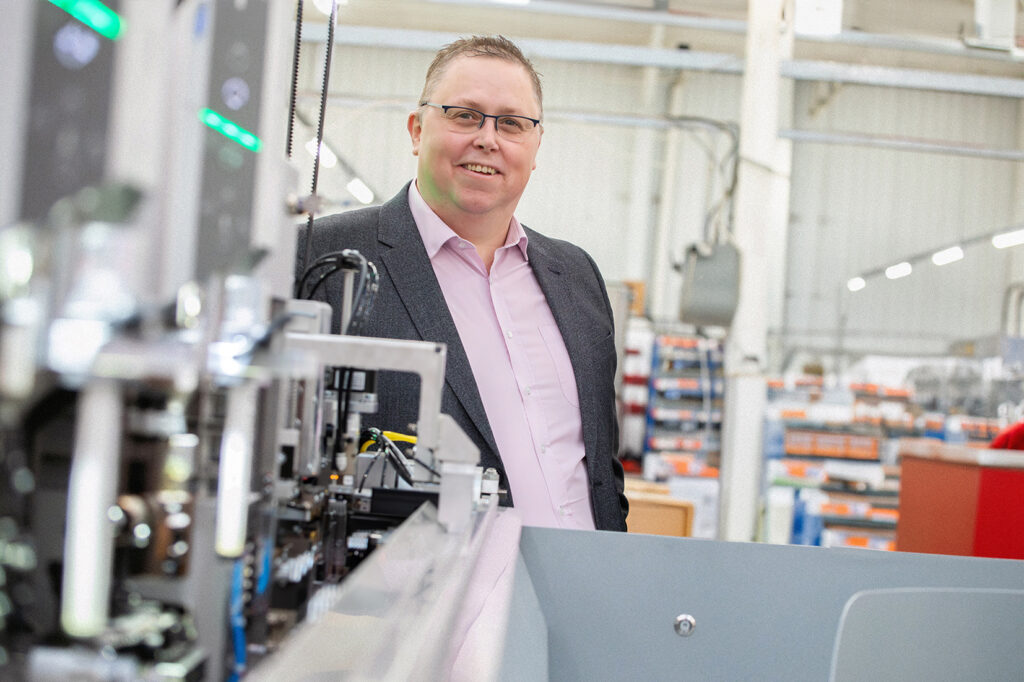
Ian Knight, who has more than 30 years’ experience in industry, said his business ignored the platform and technology noise and instead identified where its operations were being constrained.
His engineering team focused on one of the most time-intensive and resource-heavy activities in electrical engineering – extracting structured data from unstructured documentation.
Technical PDFs (which can often exceed 1600 pages) are now capable of being converted into structured, repeatable outputs. This includes embedded rules, full traceability, and the automatic identification of missing components and mismatches.
“Previously, this process required significant engineering time and manual effort. Now, those same documents can be processed in hours, not days. And this is just the starting point,” explained Ian.
“We moved in phases, creating the foundation for what follows, with subsequent phases looking at enhancing the structural data, it’s validation and integration into business systems.
“Each stage builds on the last, moving from data extraction to decision support, and ultimately to execution.”
He continued: “The result has been a 36% recovery in headcount capacity, targeting the 60% of time previously lost to manual parsing and interpretation. More importantly, it removes a key point of friction in the early stages of customer engagement, accelerating the transition from enquiry to executable work.”
PP Control & Automation, which employs over 200 people at its state-of-the-art facility in the West Midlands, is a strategic outsourcing partner for many of the world’s leading machine builders and OEMs.
It provides module or assembly-based, part or full machine build production capabilities and is responsible for machines that robotically milk cows, protect mobile phones from water damage and make F1 cars even faster.
“We’ve proven what you can achieve by embracing AI, not as a tool in isolation, but a system built around real manufacturing constraints,” added Ian.
“It has the potential to be deployed internally and also has a capability offered to customers and potentially the wider market.
“This approach avoids the trap many manufacturers face today – investing in capability without a clear path to value. Instead, it ensures that every application of AI is directly linked to a measurable operational outcome.
“For organisations looking to move from experimentation to impact, the starting question should not be ‘how do we adopt AI’ instead it should be ‘where are we constrained, and what is the most effective way to remove that constraint?’”
He concluded: “When manufacturers answer that question first, the role of AI becomes far easier to define. More importantly, it becomes far easier to justify, implement and scale. The companies who gain the most value from AI will not necessarily be those who invest the most, it will be the ones who understand their constraints the best.”
For further information, please visit www.ppcanda.com