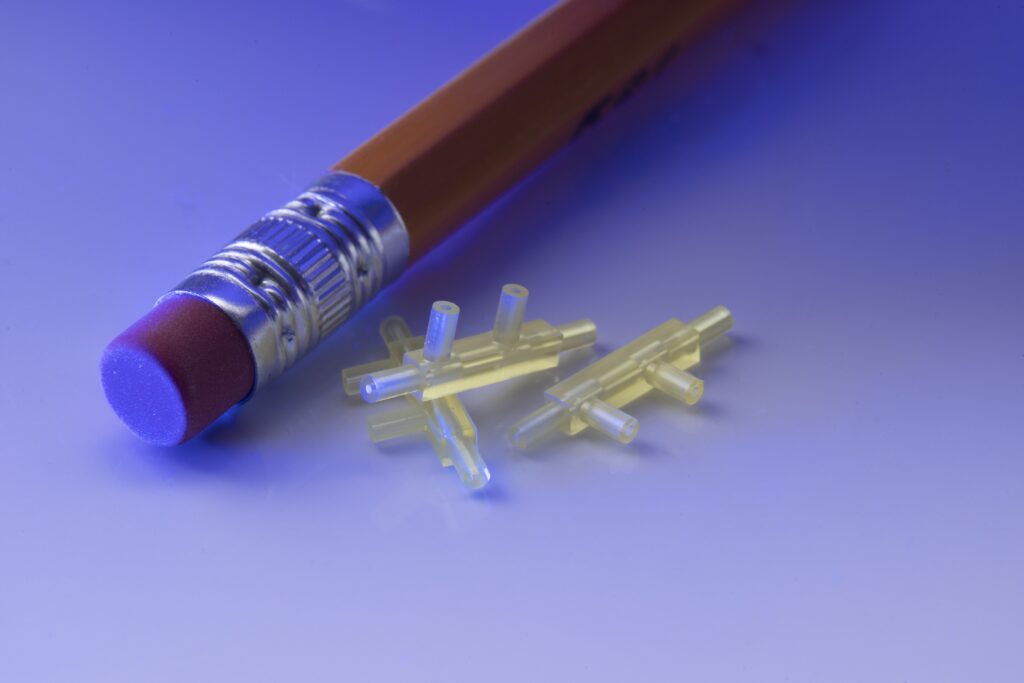
The drive to pack more functionality into ever-smaller components is reshaping manufacturing across sectors – and exposing the limits of conventional production methods. Here, Peter Ho, Product Manager, Boston Micro Fabrication (BMF) examines why micro-precision 3D printing, is emerging as a foundational technology for the next generation of precision manufacturing, and what real-world applications tell us about its growing role.
Something fundamental is changing in the way advanced products are designed and made. Across industries like electronics, medical, life sciences and optics & photonics, the same pressure is building: products are shrinking faster than the processes used to make them. Tolerances once considered exceptional – ±10 µm, wall thicknesses below 100 µm, enclosed internal geometries occupying a cross-section narrower than a few millimeters – have become baseline requirements. Miniaturization used to be a design ambition; today, it is increasingly a prerequisite for manufacturers in a multitude of application areas.
This shift is not happening in isolation; it is unfolding simultaneously across sectors that, despite their distinct engineering challenges, now face similar manufacturing bottlenecks. For instance, in electronics, component density is rising as devices become smaller, faster and more thermally constrained. Connectors, sockets and RF structures must deliver flawless alignment at scales where even a few microns of deviation can compromise performance. A similar, though differently motivated, narrative of miniaturization is playing out in medical devices. Here, the calculus is patient-centric: smaller, less invasive instruments are paramount to improving patient outcomes and reducing recovery times. What unites these diverse applications is a common manufacturing brief; extreme geometric complexity at the micro-scale, reproduced with precision, and delivered on a timeline that tooling-based processes struggle to honor.
According to Coherent Market Insights, the global micro-scale 3D printing market is at USD 1.2 billion in 2026. This is projected to reach USD 3.8 billion by 2033, representing a CAGR of 16.5%1. Biomedical devices account for 32% of this market share, but momentum is also strong in electronics miniaturization and high-density interconnects, signaling a structural manufacturing challenge becoming urgent across multiple industries.
Where conventional methods hit the wall
This demand for rapid, high-precision micro-part manufacturing is where conventional processes, such as micro injection molding, begin to reveal their limitations. Although one of the most reliable routes to high-quality small parts, this technology is constrained by tooling-dependent workflows. The need to fabricate expensive, high-precision molds introduces significant lead times – often weeks or months – and creates a costly bottleneck for iterative design. Furthermore, for development teams evaluating multiple design variants, this dynamic is particularly damaging. The cost and lead time of each tooling cycle force teams to commit to
designs prematurely or limit the number of iterations. Draft angles, ejection paths, and tool access impose hard geometric boundaries on what can be molded – particularly for parts with internal channels, enclosed cavities, or undercuts.
Another shortfall with micro molding is its inability to ensure consistency and dimensional fidelity when features drop below approximately 200 µm. Meanwhile, despite offering high precision, CNC machining is limited by the physical reach of its cutting tools, making enclosed geometries and complex internal architectures unfeasible. Methods like two-photon polymerization (TPP) and lithography deliver extraordinary sub-micron resolution, but their throughput is fundamentally limited as commercially viable production volumes are out of reach for most applications.
Across sectors, the story is the same: engineers can imagine the components they need, but they cannot always make them at the required pace and precision. The problem isn’t a lack of imagination; it is a question of manufacturability. As conventional methods hit their limits, micro-precision 3D printing is poised to fill this critical void, offering a transformative path to produce the complex, high-tolerance parts that will define the next generation of technology.
The Manufacturing Paradigm Shift: Micro-Precision 3D Printing
Among those pioneering micro-3D printing technologies resolving the mismatch between design intent and manufacturing capabilities is Projection Micro Stereolithography (PµSL). This technology delivers ultra-high resolution and surface finish required for functional micro-scale components while providing the throughput and repeatability for industrial production. Unlike traditional stereolithography (SLA), PµSL projects an entire image layer at once, enabling faster build times without sacrificing detail. Notably, it also achieves resolutions as fine as 2 µm and dimensional accuracy of ±10 µm.
This capability enables the production of complex geometries (including internal channels, enclosed structures, and fine lattice features) as single monolithic parts, eliminating the tooling overhead of conventional methods. This is more good news for manufacturers, as it means there are no molds to cut, no tooling to commission and no assembly chain to reconfigure.
Electronics: When Precision Becomes the Product
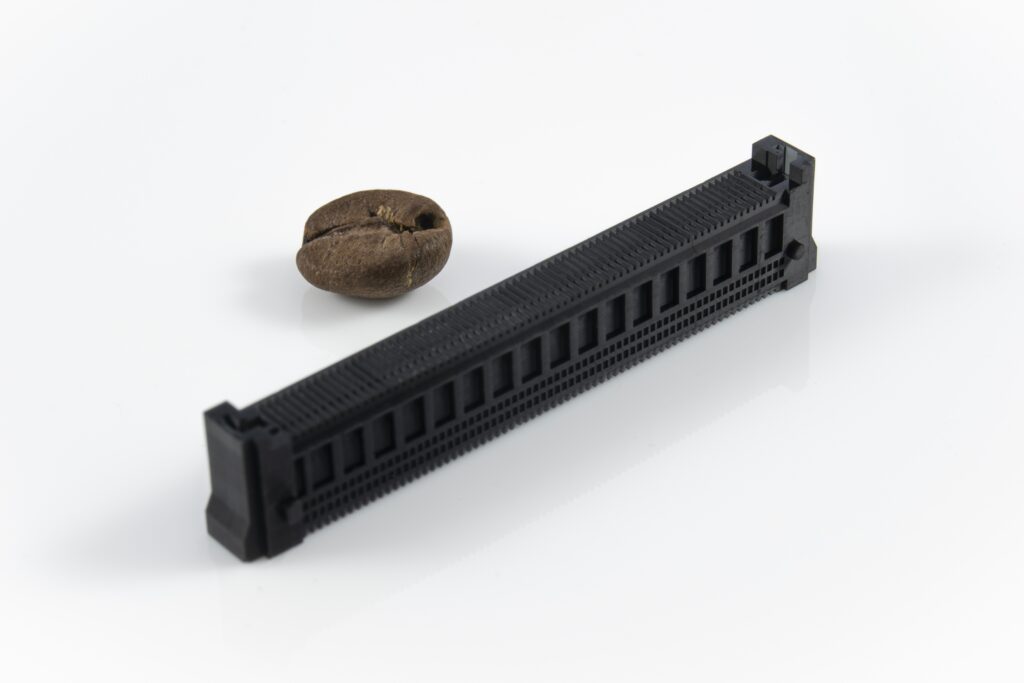
As electronic devices shrink and component density rises, the tolerance window narrows to the point where manufacturability becomes the limiting factor. The industry’s challenge is not simply making smaller parts; it is making them consistently, repeatedly and with the geometric fidelity required for high-performance electronics. Connector manufacturers feel this pressure most acutely. This is exemplified by one such company, Hirose Electric, which needed to prototype components only a few millimeters wide and 1 mm high, with pin-hole intervals of just 0.4 mm. At that scale, dimensional accuracy is binary: either the pins fit, or the assembly fails. By using micro-precision 3D printing, Hirose was able to iterate faster and at lower cost, while producing prototypes comparable to molded parts in terms of pin-angle accuracy, pore quality, and surface finish. Traditional tooling would have meant waiting up to a month per prototype cycle.
Another key advantage of PµSL technology is its ability to seamlessly bridge the gap between development and production. A compelling case is demonstrated by BRIGHT, a development
partner in the automotive and aerospace sectors, which required 18 connector variants for control-unit testing. Each variant demanded ±20 µm tolerances across as many as 120 gold-coated pins. Rather than investing in tooling, BRIGHT produced batches of 150 parts per variant directly on a micro-precision platform. No tooling investment. No mold iteration. Full flexibility to absorb late design changes. This example is a precise illustration of the production sweet spot: complex, high-tolerance parts at low-to-medium volumes, where tooling economics rarely stack up.
RF and mmWave systems add another layer of complexity, as evidenced by Germany-based, Horizon Microtechnologies. In this instance, the company leveraged micro-printed polymer monoliths with conformal metallization to produce waveguides and filters with 10-micron tolerances and surface finishes suitable for high-frequency performance. The outcomes were remarkable: showing Q-factors and insertion loss comparable to silicon micromachining, but with significantly more design freedom.
Across the electronics industry, the pattern is clear: micro-3D printing is not just a prototyping tool. Rather, it is becoming an essential part of the production workflow, enabling architectures that were previously impossible and accelerating innovation.
Medical devices: where miniaturization is a matter of patient outcome
In medtech, the stakes attached to miniaturization are different. A few millimeters must carry an entire clinical function, and precision directly affects patient outcomes. The push toward minimally invasive procedures, single-use instruments and personalized treatment is driving a wave of miniaturization that traditional manufacturing methods struggle to support.
The endoscope is a useful anchor. These types of inspection instruments used in gastroenterology now approach less than 7 mm in diameter; while those for cardiovascular use feature diameters near 1 mm. As these devices shrink, the time and complexity required to assemble them increase exponentially — which is precisely why reducing the number of assembly steps is so valuable. Micro-precision 3D printing supports that goal by enabling complex geometries to be produced as single monolithic parts, eliminating assembly joints that would otherwise introduce both failure risk and tolerancing uncertainty.
RNDR Medical, a medical device developer specializing in endoscopy, urology, and cardiology instruments, needed the distal tip of a novel single-use ureteroscope – a 3.30 mm-diameter structure – to house a high-definition camera, illumination, and irrigation channels in a precisely sealed, aligned assembly. Micro molding could achieve the required geometry, but only with costly, long-lead tooling. Ultimately, after exploring micro-precision 3D printing as an alternative, the team cut total development time in half, moving from design to a refined prototype in days rather than months.
From Tactical Tool to Strategic Imperative
Taken together, these examples converge on a single point: micro-precision 3D printing is becoming infrastructure. This innovative technology enables rapid iteration, complex micro-scale architectures, and accelerated development cycles across diverse sectors. Where
precision is a bottleneck, it provides the solution, meeting stringent specifications for low-volume production with unmatched accuracy.
This technological shift impacts product architecture, shortens development timelines, and mitigates assembly risk. It compels manufacturers to make a strategic choice: utilize micro-3D printing as a tactical design tool or embed it into their core production processes. For those who integrate it, the advantage is the capability to manufacture what the market demands with the velocity, repeatability, and process control necessary for production. Precision, in this context, is not a detail; it is a fundamental basis for the next generation of advanced devices.
Peter Ho is Product Manager at Boston Micro Fabrication