Andrew Hamilton, head of the Digital Process Manufacturing Centre (DPMC) at the National Manufacturing Institute Scotland (NMIS)
Manufacturing facilities today are sprawling, interconnected environments where equipment operates continuously and processes stretch across large physical footprints. From factory floors and plant rooms to service corridors and external assets, engineering teams need clear visibility across areas that are not always easy, or safe, to access. Maintaining performance in these conditions depends on accurate, timely information and the ability to respond before issues escalate.
Achieving that level of insight, however, is not straightforward. Manual inspections remain common, requiring engineers to walk sites, take readings, and feed information back into separate systems. The process is labour-intensive, varies from person to person, and becomes harder to sustain as facilities grow in scale and complexity. Against this backdrop, robot dogs are increasingly being explored to support inspections, monitoring, and data collection without disrupting daily operations.
The broader growth in industrial robotics helps explain this shift. More than 542,000 robots were deployed in factories globally in 2024 – more than double the number a decade ago – and annual installations have now exceeded 500,000 units for four consecutive years1. While most remain fixed to production lines, manufacturers are increasingly exploring the use of mobile robots capable of moving through operational environments in ways humans cannot safely or efficiently reach.
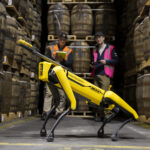
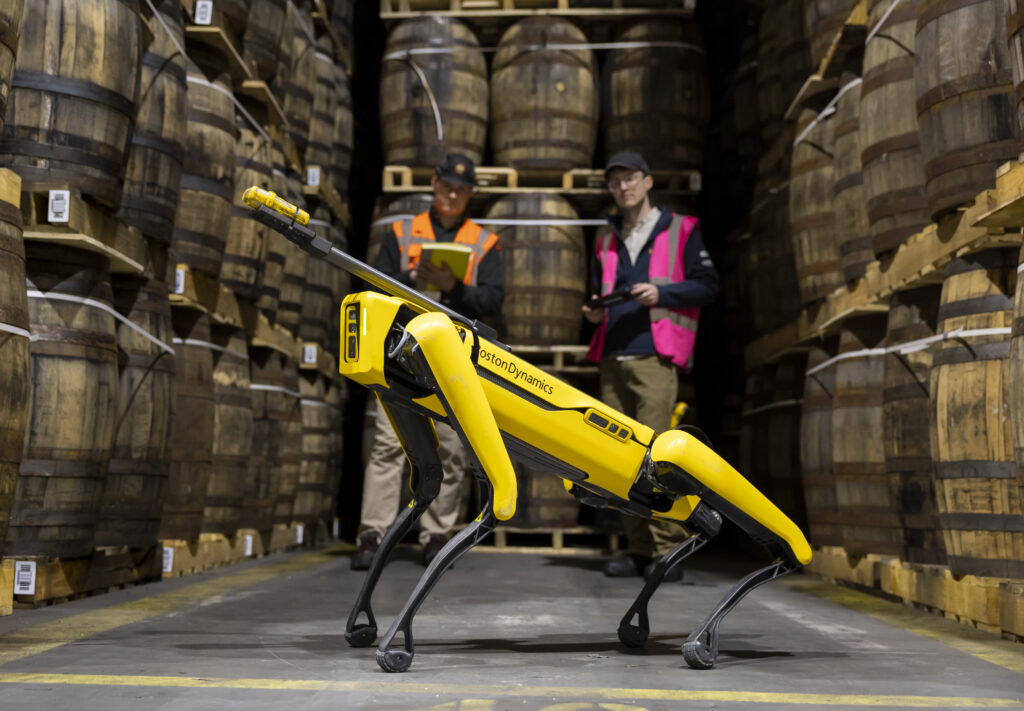
Robot dogs, in particular, are opening up new possibilities. Quadruped platforms such as Boston Dynamics’ Spot are designed to navigate spaces built for human movement rather than machinery. Able to averse stairs, uneven surfaces, and confined areas, they are ideal for inspection and monitoring in parts of a facility that are otherwise difficult or hazardous to access. Equipped with cameras, thermal sensors, or environmental monitoring tools, robot dogs follow predefined routes and collect time-stamped, location-linked data, providing a consistent, high-quality view of conditions across a site.
Beyond improving operational insight, robot dogs also enhance worker safety and efficiency. By taking on tasks in areas that would be risky for humans, they allow engineers and technicians to concentrate on analysis, decision-making, and process optimisation. Far from replacing human teams, these autonomous platforms complement them, extending reach while reducing exposure to potentially dangerous environments.
Large and complex manufacturing sites are where this approach proves especially valuable. In maritime and shipbuilding settings, facilities often span multiple compartments, with work
carried out by several contractors in parallel. Robot dogs fitted with imaging or 3D scanning equipment can move through these spaces to verify installations, identify discrepancies, and reduce the need for repeated walkthroughs, helping teams maintain oversight as work progresses.
Process manufacturing presents a different, but equally practical, application. In drink manufacturing, where utilities such as carbon dioxide are central to day-to-day operations, close monitoring is essential. Robot dogs can carry out routine checks, take meter and gauge readings, and monitor equipment condition using thermal or infrared sensing. Where abnormalities are detected, alerts can be passed directly to maintenance teams, supporting planned interventions rather than unplanned downtime.
Deploying robot dogs also prompts manufacturers to think more critically about digital readiness. Once mobile robots are operating on the shop floor, questions around network coverage, data integration, sensor selection, and ownership of information come into focus. For many organisations, this provides a practical way to explore digitalisation without the cost or disruption associated with retrofitting permanent sensing infrastructure.
The shift in digital readiness is shaping the direction of the technology itself. As payload capacities increase and software interfaces become more intuitive, integrating third-party sensors or analytics platforms now requires far less bespoke development than before. Quadruped robots already provide tangible value for inspection and data collection, and manufacturers are exploring how these platforms can be tailored to address specific operational challenges. As these capabilities advance, robot dogs are helping teams work more efficiently and respond proactively, giving early adopters a competitive edge and positioning UK manufacturing to take the lead in building safer and more resilient operations for the future.